Do you need a deposit for a construction loan? Yes, but not as one fixed figure. NAB says you’ll need to put some of your own money towards a construction loan, and that the amount depends on your land, your build and how much you borrow. If you already own the land, it may count towards your share. This guide separates three payments that people often mix up: the lender’s deposit, the builder’s deposit and the interest you pay while the home is built.
The lender’s deposit for a construction loan: land, build and the 20% test
A construction loan pays your builder in stages as the work is completed. NAB calls this progressive drawdown, and it differs from a standard home loan, which is paid out in full at settlement. NAB says buying land and building usually means two deposits, one for the land and one for the build, while owning the land means you only need the building deposit. Your land may also count towards your share of the project cost.
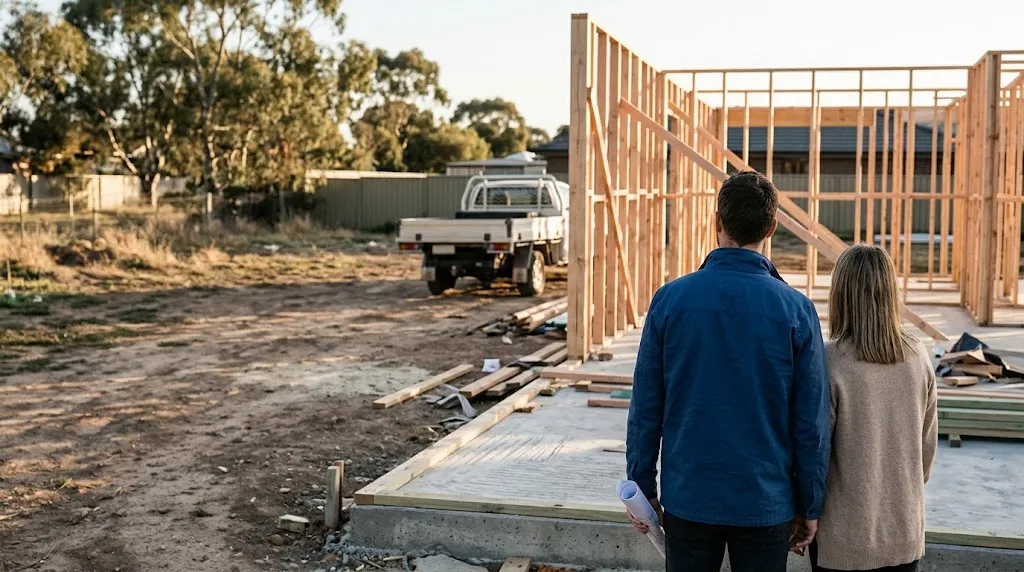
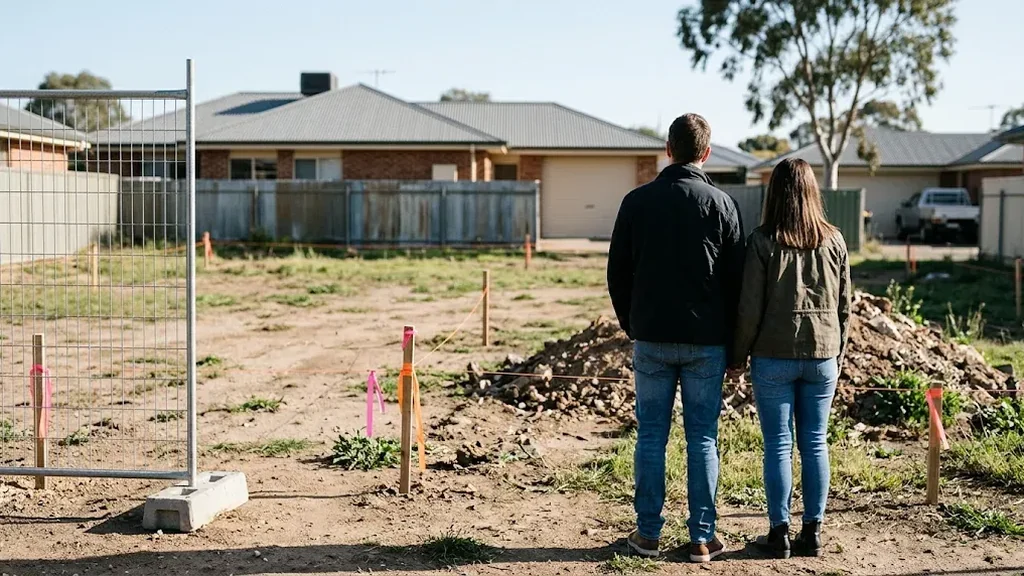
Land you already own can count towards the deposit for the build.
Whether you need lenders mortgage insurance (LMI) turns on the same test as any home loan. NAB says it is normally needed when your deposit is under 20% of the property value, unless you qualify for a government grant or scheme, and that when you build the value is the land and the finished home together. NAB values the property before building starts and again at your first and final progress claims.
The table shows three situations on a $750,000 project, made up of $300,000 of land and a $450,000 build contract. They are illustrations, and your lender will set the figures.
You own the land outright
Your own contribution: The $300,000 land
Loan: $450,000
Share of project value borrowed: 60%
You buy the land, with a 20% deposit
Your own contribution: $150,000 in cash
Loan: $600,000
Share of project value borrowed: 80%
You buy the land, with a 10% deposit
Your own contribution: $75,000 in cash
Loan: $675,000
Share of project value borrowed: 90%, where LMI normally applies
If you are buying the land, stamp duty on $300,000 in South Australia is $11,330 on the RevenueSA general scale, in addition to the deposit. Eligible first home buyers may qualify for relief, which is covered below.
The builder’s deposit in South Australia
The builder’s deposit is a different payment, and a separate rule governs it. The South Australian Law Handbook says that certain advance payments are authorised under the Building Work Contractors Regulations 2026: a deposit of $1,000 if the value of the work is up to $20,000, a deposit of 5% of the value of the work if it is over $20,000, and certain preliminary costs such as the premium for building indemnity insurance and third-party professional services like engineering, drawing and surveying. The threshold was raised from $12,000 to $20,000 on 10 November 2025.
On a $450,000 contract, 5% is $22,500. That figure is part of the price you agreed with the builder. It does not come on top of the contract price.
As part of the application, NAB asks for a copy of the signed industry standard fixed price contract, the plans, specifications and permits, and copies of insurance policies, including builders all risk, domestic or home warranty, and public liability insurance. Ask your lender how it treats the builder’s deposit, because the timing of your own payments and the lender’s first drawdown can leave a gap that you need to fund.
What the loan costs while you build
Because the lender pays the builder in stages, you pay interest only on what has been drawn. NAB gives the contrast: if you drew the full amount at the start you would pay interest on all of it from day one, while drawing in stages means your interest grows as you draw more, which is why it is worth budgeting for.
Each stage of the build is paid as it is completed.
Here is the arithmetic on a $450,000 build at 6.2%, the RBA’s August 2026 average for existing variable-rate owner-occupier loans.
Amount drawn so far
$225,000, half the contract
$450,000, the full contract
Your own stages and amounts depend on your builder’s contract. Add the months of interest to whatever you pay in rent or on your existing home loan while the house is built, because those costs overlap. A buffer for that period is part of the real deposit.
If you buy the land first and build later
Many people do not have a builder when they find the block. NAB’s approach is to start with a land loan, which covers the land only, and look at a construction loan for the build once you have chosen a registered builder and have a fixed price contract. That means two assessments, a deposit for the land now and the lender’s own contribution test later, and the second one is run on your income and expenses as they stand then.
Time also matters for the stamp duty relief described below. For vacant land, RevenueSA’s residence requirement is at least six continuous months in the finished home as your principal place of residence, starting within 12 months of the date you can lawfully use the home, or 36 months from settlement, whichever comes first. A long gap between buying the block and finishing the house can use up that window.
Grants and relief if you build in South Australia
RevenueSA says the First Home Owner Grant of up to $15,000 applies to a contract to build, to buying a new home or an off-the-plan apartment, and to owner-builder construction, but not to the purchase of vacant land on its own. For stamp duty, RevenueSA says relief covers vacant land you intend to build your principal place of residence on, and that full relief is available for contracts entered into on or after 13 February 2025, regardless of property value.
On a $300,000 block, that relief would remove the $11,330 of duty for an eligible first home buyer. Eligibility rules apply, including the previous property ownership test and a residence requirement, and the grant and the relief are separate applications. The Australian Government 5% Deposit Scheme, available through participating lenders, is another route that can lower the deposit and avoid LMI for eligible first home buyers. It covers building on vacant land, subject to the price cap for the location, which your participating lender confirms.
Questions to ask before you sign the building contract
- Which value will the lender use, and is it the land plus the finished home?
- Does my land count towards my share, and by how much?
- How does the lender treat the builder’s 5% deposit?
- Do the payment stages in my contract match the lender’s progress claims?
- Which insurance policies must be in place before the first payment?
- What happens to the loan if the build costs more than the fixed price?
Staging, deposits and interest during the build all come from your builder’s contract and your lender’s policy. A
construction loan broker can read the two against each other before you sign either.
Frequently asked questions
Do you need a 20% deposit for a construction loan?
Not always. NAB says LMI is normally needed when the deposit is under 20% of the value of the land and finished home together, unless you qualify for a government grant or scheme. Lenders set their own deposit requirements.
Can land count as my deposit?
NAB says that if you already own the land, you will only need the building deposit, and your land may count towards your share of the project cost. How much it counts depends on the lender.
How much is a builder’s deposit in South Australia?
A deposit of 5% of the value of the work if the contract is over $20,000, and $1,000 for work up to $20,000, under the Building Work Contractors Regulations 2026.
Do you pay interest on the whole loan from the start?
No. NAB says funds are released in stages as each part of the build is finished, and you pay interest on the amount drawn so far.
What does the lender need before it releases funds?
NAB asks for a signed fixed price contract, plans, specifications and permits, and copies of the required insurance policies as part of the application.
Can first home buyers get a grant to build?
RevenueSA says the First Home Owner Grant can apply to a contract to build and to owner-builder construction, if the eligibility criteria are met. It does not apply to buying vacant land alone.
Is stamp duty payable on the land?
It is payable unless an exemption or relief applies. RevenueSA says eligible first home buyers may receive full relief on vacant land they intend to build their principal place of residence on, for contracts on or after 13 February 2025.
Do I need a fixed price contract?
NAB asks for a signed industry standard fixed price contract from your registered builder as part of the application.
Talk to us before you sign a building contract.
This article is general information only and does not take into account your objectives, financial situation or needs. The project, deposit and interest figures are worked examples at assumed values and rates and are not offers. Lender policies, grants and building rules change, so check each source before you rely on it.
Sources
- NAB, How do construction or owner builder loans work?
- Legal Services Commission of South Australia, Law Handbook, Building Work Contracts
- RevenueSA, First Home Owner Grant, eligible properties
- RevenueSA, Stamp duty relief available for first home buyers
- RevenueSA, Stamp duty on conveyances calculator
- Australian Government, 5% Deposit Scheme
- Reserve Bank of Australia, Statistical table F6, Housing lending rates (August 2026)